
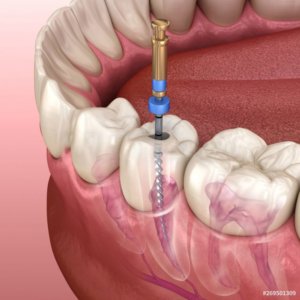
It’s easy to come up with excuses for postponing a root canal procedure. Whether it’s due to the fear of possible discomfort or the concern for how long a root canal can take—or even for the time it might take to locate a root canal specialist—putting it off is not only delaying the inevitable, but may also be causing bigger problems. The tooth is infected and dying; a root canal stops the infection: While the outer layers of the tooth are hard, the inner pulp is made of soft, living tissue. This tissue sometimes becomes infected (through deep decay, cracks in the tooth surface, etc.), and begins to die. Once that happens, treatment is needed right away — to stop the pain, control the infection, and keep it from spreading. Root …
Here our dentists we discuss a wide range of topic pertaining to Endodontic care. Learn about root canals, cracked teeth, teeth sensitivity, and more.

Cracked Tooth: Types, Symptoms & Treatments
You may suspect you have a cracked tooth if you experience sharp pain when biting which quickly disappears. Cracked teeth are relatively common and a generally a by-product of having fillings as well as bruxism, or night-time teeth grinding. Amalgam fillings are notorious for causing the right conditions for crack development in teeth. Because amalgam has a property called dynamic creep, every time pressure is applied to the top of the filling, it deforms slightly by pushing outwards against the walls of the tooth which contains it. After enough time, cracks can form in the tooth structure, eventually leading to the loss of a portion of the tooth or in the worst case, a complete split. Bruxism provides intense forces which can cause …

How a Root Canal Can Save Your Tooth
If you have a severely damaged, decaying tooth or a serious tooth infection (abscess), your dentist may recommend a root canal treatment. Root canals are used to repair and save your tooth instead of removing it. What’s Involved in Root Canal Repair? The pulp is soft tissue inside your tooth that contains nerves, blood vessels and provides nourishment for your tooth. It can become infected if you have: A deep cavity Repeated dental procedures that disturb this tissue A cracked or fractured tooth Injury to the tooth (even if there’s not a visible crack or chip) If untreated, the tissues around the root of your tooth can become infected. When this happens, you will often feel pain and swelling and an abscess may form inside …

Endodontics
What is Endodontics? Endodontics is the specialty of dentistry that deals with the tooth pulp and tissues surrounding the root of a tooth. The pulp, which contains nerves; arterioles and venules as well as lymphatic tissue and fibrous tissue, can become diseased or injured and thus is unable to repair itself. The pulp then dies and endodontic or root canal treatment is required. General dentists may provide root canal therapy or they may refer difficult treatment cases to an endodontist for specialty care. Some of the procedures used in endodontics include: Root canal treatment - This is one of the most common procedures for treating the dental pulp in moderate-to-severe cases of tooth decay. The infected tooth is opened up at the …